Get my book for free

The End of All Our Exploring is a book about trying to delve deeper with your friendship with God. From my own personal life to my professional experiences as a psychologist and pastor, it investigates what it actually takes to create a relationship with God that is fulfilling. It is a book (in Kindle or iPad format) which I am giving you for free, when you enter your email below and subscribe to the blog.

Email:
May
14
2013

cummings

Poetry today is a lost art and one which we need to refind. Back in the begin­ning of the last cen­tury, some of the most famous and pop­u­lar writ­ers were poets and we need to recap­ture this art and make it com­mon place again.

E.E. Cum­mings is prob­a­bly my favorite poet. Ever since I bought his Com­plete Poems back in 1987 his words, which are play­ful and some­times mis­aligned, have always cap­tured what lyri­cal and pro­found writ­ing could become.

May his words inspire you to enjoy this day.


i thank You God for most this amaz­ing
day: for the leap­ing greenly spir­its of trees
and a blue dream of sky; and for every­thing
which is nat­ural which is infi­nite which is yes

(i who have died am alive again today,
and this is the sun’s birth­day; this is the birth
day of life and love and wings;and of the gay
great hap­pen­ing ilim­itably earth)

how should tast­ing touch­ing hear­ing see­ing
breath­ing any — lifted from the no
of all noth­ing — human merely being
doubt unimag­in­able You?

(now the ears of my ears awake and
now the eyes of my eyes are opened)


In: What I've Been Reading
Tags:
May
09
2013

radioThis post is from a larger series under the cat­e­gory Friend to Jesus. It is a detailed explo­ration of the three stages of faith: the believer, the ser­vant and the friend of God. If you want to start at the begin­ning, it begins with the post How Look­ing at a Car­avag­gio Paint­ing Can Change Your Life and then con­tin­ues chronologically.

‘The law of Jeho­vah is per­fect, restor­ing the soul.’ (Psa. 19:7). Most laws con­demn the soul and pro­nounce sen­tence. The result of the law of my God is per­fect. It con­demns but for­gives. It restores—more than abundantly—what it takes away. Jim Elliot

If you live in Chicago, you know that you nat­u­rally spend a lot of time in your car because of traf­fic and get­ting from Point A to Point B. On these stop-and-go dri­ves, I usu­ally lis­tened to Chicago sports radio. The Bulls were win­ning cham­pi­onships left and right and it was fun lis­ten­ing to the ban­ter about the pride and joy of our city.  If you know me, you know that I am not a reg­u­lar lis­tener to Chris­t­ian radio or tele­vi­sion. How­ever, that night for some rea­son I turned the dial to some Chris­t­ian radio sta­tion being piped in from one of the sub­urbs. That night dri­ving down Roo­sevelt Avenue lonely and sad, I inad­ver­tently came across Bob George’s Peo­ple to Peo­ple radio pro­gram. If you have ever lis­tened to Bob George or read his books you know that he talks about one thing over and over at great length—God’s grace. For the first time, as I was lis­ten­ing to his words, God began show­ing me a grace I had not seen before—one that I actu­ally began to expe­ri­ence. In that car ride, lis­ten­ing to his South­ern twang talk about accep­tance, it opened up my eyes like never before. It was as if Jesus mixed some mud together, rubbed it on my eyes and then com­manded me to open them. A cou­ple of days later I grabbed Bob George’s book Grow­ing in Grace off the book­shelf at a store and took it home. I read it in one sit­ting and in that time came across this pas­sage below:

Now real­ize that I am talk­ing about our­selves being accept­able to God, not nec­es­sar­ily our actions. In my iden­tity I am eter­nally accept­able to Him, but that doesn’t mean that every­thing I do is all right. He may put His arm around me, so to speak, and show me the truth about some­thing in my life that is out of line: an atti­tude, action, or habit. Why? So He can change my atti­tude that is out of line, result­ing in a change of action. But at no time is His accep­tance of me ever in question.

But at no time is His accep­tance of me ever in ques­tion. This was one of the miss­ing pieces for me. I knew some­thing like this in con­cept, but had yet to expe­ri­ence it. Now I began to do that or as the psy­chol­o­gists term, I began to inter­nal­ize this truth.

Dur­ing that period in my life, Jesus was also say­ing that some sig­nif­i­cant changes needed to occur in my life so that I could really begin to under­stand that free­dom he desired for me. At that point, I made a com­mit­ment to not date any­one, even casu­ally. Like­wise, I decided I needed to pur­sue friend­ships with men, which for the most part was a bit of a chal­lenge for me. Hang­ing out with women even from a young age was eas­ier for me and for the most part, I enjoyed their com­pany more than hang­ing out with the guys. How­ever, I began to see that this on some level was con­tribut­ing to my prob­lem with hav­ing healthy rela­tion­ships with women. With this deci­sion, not until years later did I real­ize that in this time of heal­ing for me, as I was purs­ing my rela­tion­ship with God, I was also pur­su­ing heal­ing in terms of what it meant to be a man. I also decided to remove myself from any min­istry con­text and began read­ing vora­ciously books on sex­ual heal­ing. Specif­i­cally, the works of Wal­ter Tro­bisch had a tremen­dous influ­ence on me; his books speak openly about sex­ual issues from a Chris­t­ian per­spec­tive and address cer­tain issues that most books writ­ten at that time wouldn’t touch with a ten foot pole.  Jesus, no dif­fer­ent than with Peter, had flipped my world upside down and it was an amaz­ingly lonely, but heal­ing time in my life. In essence, with all that he was doing in my life, he was say­ing that I had all this focus on min­is­ter­ing to oth­ers, but that I had got­ten the cart before the horse, and that first, he needed to min­is­ter to me. Some­thing, for the most part, I had never allowed him to do.

Iron­i­cally, at the end of the day, the main way in which Jesus dealt with me in this heal­ing in terms of all these rela­tional and sex­ual issues was that he sim­ply for­gave me and just as impor­tantly, taught me how to for­give myself. Strangely, these were the two key com­po­nents that began to change my behav­ior. Yes, I was read­ing books, seek­ing coun­sel, and doing a myr­iad of other things to attempt to bring change to my life, but it was these two pieces that began to trans­form me—His for­give­ness and my own for­give­ness toward myself. I, for the first time in my life, had truly expe­ri­enced for­give­ness beyond just know­ing it in text-book fash­ion and in word only.

In par­tic­u­lar, I can remem­ber one day when I was read­ing the Bible, God through His words basi­cally said, Buddy, there are a lot of other areas of your life that you pay lit­tle atten­tion to that need even more change than just this area of lust. I remem­ber that moment because it struck me that I began to see that in some ways the sin of pride was just as dam­ag­ing to myself and to oth­ers as what my sex­ual sin could be. This was a free­ing moment for me. It made me real­ize how focused I was on this one area of my life, but was neglect­ing so many oth­ers. Again, God was teach­ing me in a way only that he could, that I was a sin­ner through and through to the very core. Through this relin­quish­ment, not only did I begin to heal, but I mirac­u­lously began to change. The beauty of this time, now that I look back at it now, was that even though I was in this com­pletely bro­ken state, Jesus was extremely patient with me and slowly, but surely was in the process of chang­ing me for the better.


In: Friend to Jesus
Tags: , , , , ,
May
03
2013

Bought this on vinyl two weeks ago by Explo­sions in the Sky.  The song title is Be Com­fort­able, Creature.

It’s worth your time.


In: Spiritual Formation, What I've Been Listening To
May
02
2013

helpThis post is from a larger series under the cat­e­gory Friend to Jesus. It is a detailed explo­ration of the three stages of faith: the believer, the ser­vant and the friend of God. If you want to start at the begin­ning, it begins with the post How Look­ing at a Car­avag­gio Paint­ing Can Change Your Life and then con­tin­ues chronologically.

After loss of iden­tity, the most potent mod­ern ter­ror, is loss of sex­u­al­ity. Jeanette Winterson

 I had my own expe­ri­ence in which I had lived a ser­vant too long. Iron­i­cally, just as my move from believer to ser­vant began in a car ride, in a way, so did my trans­for­ma­tion to becom­ing a friend to Jesus. As I have said before, for about ten years I lived in Chicago. It is a city I deeply love with my Chicago Cubs (yes, I am a glut­ton for pun­ish­ment), the lakeshore, its unique archi­tec­ture, and deep-dish pizza. While liv­ing there a cou­ple of years after col­lege, I was now a cou­ple years in my first “offi­cial” job. I worked for a large cat­a­log com­pany as a print and paper buyer and loved my job with all of its perks. I often ate at some of the best restau­rants, got to see Michael Jor­dan play on many occa­sions, and because of my posi­tion, I was schmoozed on a reg­u­lar basis by the other com­pa­nies that I worked with on the dif­fer­ent projects I oversaw.

How­ever, a cou­ple of neg­a­tive things were also hap­pen­ing, espe­cially in my rela­tion­ship with God and in my per­sonal life. First, I was becom­ing cal­lous in my faith and jaded. I had been a Chris­t­ian for some years, had moved into var­i­ous places of lead­er­ship and was begin­ning to like that spot­light. In my early years as a Chris­t­ian I threw myself into many endeav­ors and slowly but surely was get­ting burned out and basi­cally, becom­ing tired of being a Chris­t­ian. I was lead­ing Bible stud­ies; men­tor­ing a cou­ple of ram­bunc­tious sev­enth graders through Big Broth­ers; try­ing to get off the ground a col­lege min­istry at the school I grad­u­ated from; attend­ing not one, but three dif­fer­ent churches. You name it, I was doing it. The prob­lem was…I also try­ing to keep up appear­ances, because what once seem­ingly was a thriv­ing faith had dete­ri­o­rated. And here was the big problem—the prob­lem was that if you knew me then you would have never known that by look­ing at all that I was doing. You would have thought I was this great guy who had it all together, serv­ing God and serv­ing oth­ers. How do I know this? Because at that time so many around me told me this in not so many words. I had become a very gifted actor and was fit to be the next Robert De Niro.

And under­neath all of this, issues from my past had sur­faced and secret sins began to pile up. On the sur­face every­thing looked like it was in work­ing order, but inside I was hol­low and there were so many prob­lems in my life that I wasn’t rec­og­niz­ing. First, I was begin­ning to grow an anger within myself that seem­ingly just showed up one day. I was hard to please. I was putting high expec­ta­tions on oth­ers, but rarely myself. While up to that point in my life, anger had never really been a strug­gle or prob­lem, how­ever, now inside I was seething. I often would walk around just a bun­dle of annoy­ance and cha­grin. I almost never showed this to oth­ers, but inside anger had taken a foothold in my life. Sec­ond, I had become very arro­gant and pride­ful. I would go to church and not lis­ten to the ser­mon for self-reflection, but to cri­tique what was being spo­ken. With oth­ers, when some­one would have an opin­ion on some given issue, I often had to dis­agree. Being a Chris­t­ian had turned into for me an intel­lec­tual exer­cise and not a spir­i­tual one. That’s not how you inter­pret that pas­sage! Boy, was that ser­mon bor­ing! That’s not what Jesus meant when he said “Love your ene­mies!” Because I had been a Chris­t­ian for some years, I was slowly becom­ing a know-it-all and if some­one dis­agreed with me, I could almost in every occa­sion con­vince them oth­er­wise. At that time, I learned this—sadly, rarely do peo­ple ask tough ques­tions of their leaders.

To top this off, while I had lots of friends, I was dis­tanc­ing myself from them—I care­fully hid who I was becom­ing and where I was strug­gling. In par­tic­u­lar, there was one part of my life which was unrav­el­ing and was reveal­ing my bro­ken­ness at its deep­est levels—its roots, which were nearly twenty years old. Through var­i­ous expe­ri­ences in my child­hood that had hap­pened to me, some which we would now name as sex­ual abuse, my sex­u­al­ity had become an intri­cate and acute wounded part of me. Like so many that I have met in my prac­tice and in my role as a pas­tor, my sex­u­al­ity had been opened up way before it should have been, and with this, the dam­age that was done was com­ing to bear. Over the years, in par­tic­u­lar start­ing in my late teenage years, but espe­cially in my early twen­ties, I was slowly devel­op­ing a depen­dency on unhealthy rela­tion­ships, specif­i­cally those that turned sexual.

This bro­ken­ness orig­i­nated at some of my first mem­o­ries. I became promis­cu­ous at an early age, in part because of these child­hood expe­ri­ences that I men­tioned ear­lier. Like­wise, while in mid­dle school, the door had been abruptly slammed open with some inci­dents with a high school girl who lived down the street and who was a cou­ple of years my senior. We would sneak away to secret places dur­ing the sum­mer nights of my eighth grade year and she opened up a world to me that was intox­i­cat­ing and dan­ger­ously mys­te­ri­ous. As I have told many, pornog­ra­phy for the most part has never been a strong urge for me, pri­mar­ily because of these early expe­ri­ences. I did not yearn for vir­tual expe­ri­ences; I wanted the ones that had flesh and warmth asso­ci­ated with them. These sex­ual crav­ings took hold of me at a very early age and would fol­low for me years to come.

Toward the end of my high school years, this solid­i­fied in an even more dam­ag­ing way—in my fresh­man year in col­lege, a woman in her twen­ties who was very “expe­ri­enced,” entirely opened up that part of my life intro­duc­ing me to a world which I had not quite imag­ined. Up to that point, for all intents and pur­poses, I had been dab­bling with sex and in this rela­tion­ship I gave in full blown to my desires. And of course, by no means was I an inno­cent bystander in all of this—I was enthralled with this lifestyle and at that same time, could not see its dangers.

As I men­tioned in an ear­lier post, in my early twen­ties, I was out of con­trol and did not have the capac­ity, knowl­edge or courage to stop what I was doing. I had recently become a Chris­t­ian, but this trans­for­ma­tion had yet to invade my rela­tion­ships with women. While I might have been hav­ing lots of sex, in truth, I was begin­ning to lose my sex­u­al­ity and in some way, was los­ing my capac­ity to love a woman. I wouldn’t of course under­stand this for years to come, but the ground work had been laid. In these years, I was in many rela­tion­ships with women, most were just based on hav­ing both of our sex­ual needs met. There were a hand­ful of Sat­ur­day morn­ings that I would awaken next to a woman at my side and I would lay there in a tremen­dous amount of guilt and shame because of this dual life I was liv­ing. The wounds from my sex­ual past had finally caught up with me, but I did not know what to do.

At about age twenty three, I real­ized I had to some­how try to get things in respectable order. The prob­lem was—I did all this on my own, try­ing to piece together some­thing that would bring some sem­blance of well-being. For the next cou­ple of years, I man­aged to keep things together, but only barely. It was at this point where I re-committed my life to God which I detailed in a pre­vi­ous post. I seri­ously dated a cou­ple of women and was try­ing to take my faith more seri­ously as well. With the cou­ple of com­mit­ted rela­tion­ships that I did have in those years, on the sur­face they seemed like they were healthy rela­tion­ships, but in real­ity, we were two peo­ple who had not wres­tled with the demons of our past and present. Often in these rela­tion­ships, I was the overly depen­dent one and in real­ity these rela­tion­ships were becom­ing a sub­sti­tute for my rela­tion­ship with God. I knew I had a seri­ous prob­lem when one Sun­day I was stand­ing next to my girl­friend at church and in see­ing her in wor­ship; I became jeal­ous of her love toward God. Can you imag­ine that? I was jeal­ous of God! I remem­ber feel­ing that emo­tion and think­ing he was going to strike me dead at that very instance. At that point, I knew things were really bad and that what I was try­ing to do was bring­ing very lit­tle heal­ing to my life.

It all cul­mi­nated one night at my girlfriend’s apart­ment, in which, in too many words, we had another great argu­ment about our rela­tion­ship. That evening, we both decided to mutu­ally break things off and that was the begin­ning for me in pur­su­ing my own heal­ing and relin­quish­ing my crav­ing for women to make me happy and whole. Relieved and dev­as­tated at the same time, that evening as I was dri­ving home in my car, I heard a whis­per of a voice, which to para­phrase, basi­cally said, Dude, you need to get some help. Jesus was cry­ing out for me to pur­sue heal­ing instead of rela­tion­ships, and soon I was about to finally relent. Remark­ably, Jesus was going to begin to heal me in a way that was about as strange as when he used mud and spit to make a blind man see.

Next time, I will tell you how he did that…


In: Friend to Jesus
Tags: , , , , ,
Apr
29
2013

The streets are paved now.
Mon­day morn­ing, the noise of rub­ber and asphalt.
Mon­day morn­ing, the quiet bal­anced between two peo­ple walk­ing down an alley way.
We waked up hear­ing the sound.
It was not singing.
It was curled.
It was like singing and it wasn’t singing.
And then it stopped and we heard the sound as if nobody had made it.


In: Poetry
Tags: ,
Apr
27
2013

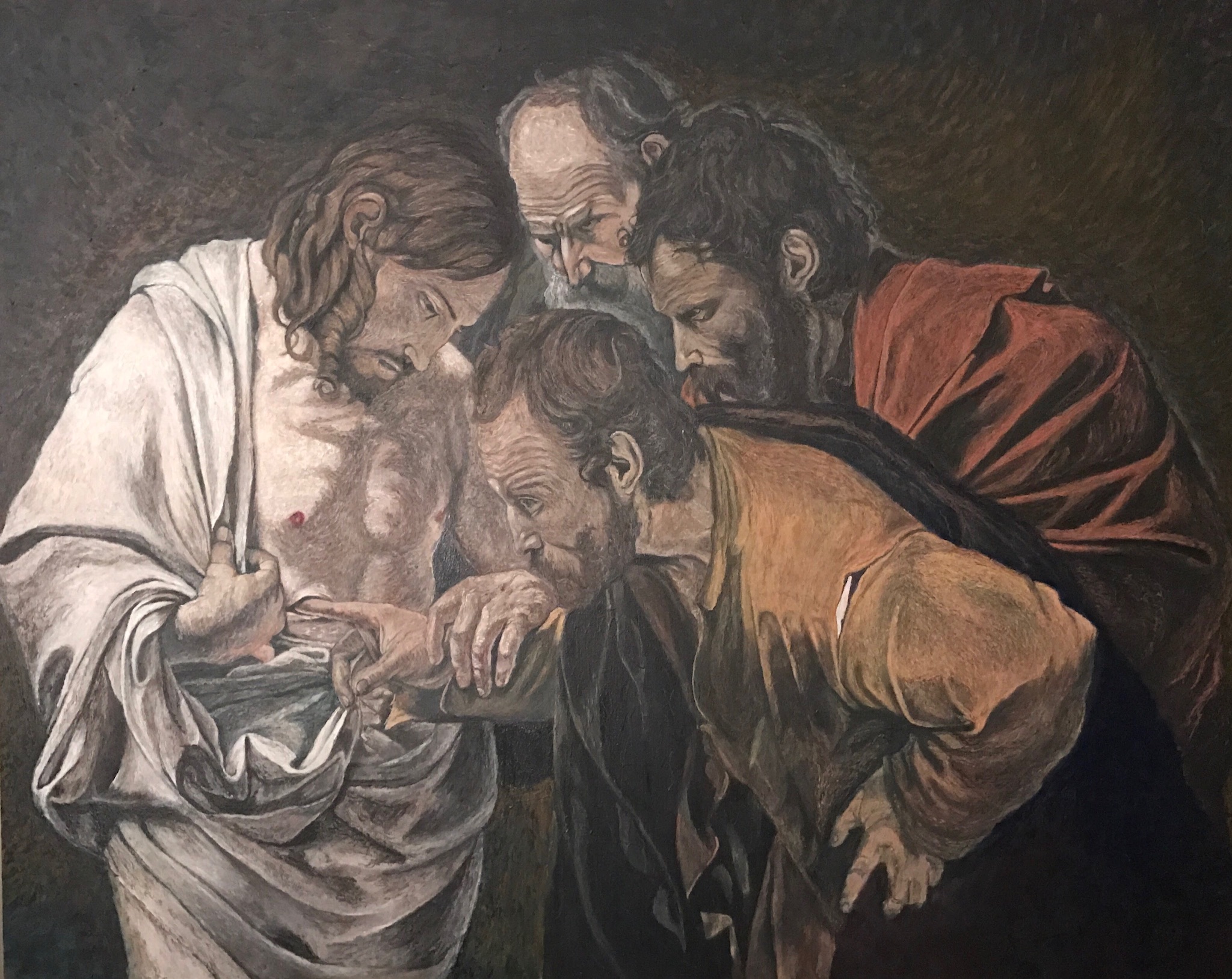
Doubt­ing Thomas (2001), Mixed media on paper

(Click to enlarge)


In: Painting
Tags: , , ,
Apr
27
2013

IMG_0220

Tree-Lit Dawn (2013), Water­color on paper

(Click to enlarge)


In: Painting
Tags: ,
Apr
27
2013

it is this
this morn­ing
mis­un­der­stood
some­where beneath sud­den
with first words
out­stretched
like stealth
strung by its
smooth-stilled legs

venet­ian silence
abreast
a blink
and undressed open
beside over under
fur­rowed whis­per
choir cer­tain
a vest­ment kiss
piece by piece

uprooted
savor of coral
of autumn reach
and another
gath­ered or beheld
imper­fect
side­step into twist
arisen touch
woven and
kept


In: Poetry
Tags: ,
Apr
18
2013

[To have faith in Christ] means, of course, try­ing to do all that He says. There would be no sense in say­ing you trusted a per­son if you would not take his advice. Thus if you have really handed your­self over to Him, it must fol­low that you are try­ing to obey Him. But try­ing in a new way, a less wor­ried way. Not doing these things in order to be saved, but because He has begun to save you already. Not hop­ing to get to Heaven as a reward for your actions, but inevitably want­ing to act in a cer­tain way because a first faint gleam of Heaven is already inside you.

C.S. Lewis


In: Spiritual Formation
Apr
18
2013

god likeThis post is from a larger series under the cat­e­gory Friend to Jesus. It is a detailed explo­ration of the three stages of faith: the believer, the ser­vant and the friend of God. If you want to start at the begin­ning, it begins with the post How Look­ing at a Car­avag­gio Paint­ing Can Change Your Life and then con­tin­ues chrono­log­i­cally. 

I do not want to be the inher­i­tor of so many mis­for­tunes. I do not want to con­tinue as a root and as a tomb. Pablo Neruda

 As I said ear­lier in the blog, how we view God is all-important. It is the under­pin­ning of our entire life. Most often, our view of God comes from two places in our lives: 1) from how we were raised, i.e., from our par­ents and our upbring­ings; and 2) what we are taught from oth­ers either directly or indi­rectly. Again, as we look at Peter’s life, on a few dif­fer­ent occa­sions, Jesus had to cor­rect him in terms of his view of God (Matthew 16:23, John 13:3–9, Acts 10). Jesus com­pletely under­stood that if Peter did not change some of these views, every­thing else would also get bent and dis­torted in his life. Jesus clearly saw this in the reli­gious lead­ers of his time and he didn’t want these same atti­tudes and behav­iors to con­tinue in Peter.

There is one com­mon denom­i­na­tor when it comes to those who are stuck in this phase of faith of being the servant—they inevitably see God as the stern father—Someone who has expec­ta­tions that can never be met. Now, none of this is out in the open; these views are emo­tion­ally held in the sub-conscious and in the deep part of the person’s soul. This truly is how they see God—he cares very lit­tle for them. If you were to ask them to name some of God’s char­ac­ter­is­tics they would be able to per­fectly and even elo­quently share with you these:

  • God is good.
  • God is gracious.
  • God is loving.
  • God is forgiving.

But in truth, to inter­nally expe­ri­ence these real­i­ties on a daily basis, they don’t even come close. Deep inside, deep within their soul, God is not good or lov­ing or for­giv­ing. And with this, here is a sim­ple test in how you can deter­mine how a per­son gen­uinely sees God—don’t ask them how they view God—ask them how they view them­selves. Don’t let them think about the ques­tion, just ask them for the first words that come to their mind. Inevitably, the per­son caught in this stage of faith will use the major­ity of their descrip­tion with words such as these: a sin­ner, bro­ken, wicked, evil, a fallen per­son. In how they view them­selves, we begin to see a pic­ture of how they might view God. They will not use true words such as these—righteous, saved, holy, redeemed, a child—such words would not be the ones that would first come to their mind.

Those who are caught in this ser­vant stage of faith need to assess truly how they view God. They need to get beyond the sim­ple men­tal con­cep­tions that they have learned and look at who God is gen­uinely to them right now. But here is the tough part with this self-reflection—you often need some­one else in your life who knows you extremely well to help you answer these ques­tions of who God is to you. With the per­son who is stuck in this phase, as men­tioned in a pre­vi­ous chap­ter, too often this is a no-no; you do not get close to oth­ers and you def­i­nitely don’t need the help of others.

Often these deep-seated ideas of who God is began a long time ago in a land far, far away. Some­times a per­son stuck here will need to deal with issues from the past and often these issues might be dif­fi­cult to acknowl­edge or deal with because of the pain or con­fu­sion asso­ci­ated with them. Some of these dif­fi­cult issues to address might be:

  • How you were raised – espe­cially grow­ing up in home in which per­fec­tion was always required or where a par­ent was emo­tion­ally distant
  • Being phys­i­cally, emo­tion­ally or sex­u­ally abused in the past
  • Fac­ing a trau­matic event that occurred in your life
  • Hav­ing a par­ent who was extremely dom­i­neer­ing or passive
  • Grow­ing up in a home that was overly reli­gious (overly empha­siz­ing the rules of the faith over grace and forgiveness)

FACING THE WOUND OF REJECTION

There is an impor­tant con­cept from psy­chol­ogy that might help you under­stand one dynamic of this in terms of one’s up-bringing. Gre­gory Bate­son, a lin­guist and anthro­pol­o­gist, wrote in the 1950’s about the con­cept of a dou­ble bind; it is a term that is used when chil­dren grow up with incon­sis­tent and neg­a­tive parental mes­sages. Dou­ble binds usu­ally are most dam­ag­ing within the rela­tion­ship of a par­ent to a child; how­ever,  they can also occur in dif­fer­ent types of rela­tion­ships such as with sib­lings, extended fam­ily rela­tion­ships, within dat­ing or mar­riage rela­tion­ships and friend­ships. Here is the basic process of how a dou­ble bind occurs within the rela­tion­ship of a par­ent and child:

  • Stage One: Con­fu­sion. First, the child who expe­ri­ences a dou­ble bind receives con­tra­dic­tory ver­bal and emo­tional mes­sages when they are spo­ken to by their par­ent. For exam­ple, love is expressed by words, and yet dis­gust or detach­ment is exhib­ited by behav­iors by the par­ent. Like­wise, a child is encour­aged to speak freely, but then crit­i­cized or silenced when­ever they actu­ally do share their view on a given issue.
  • Stage Two: Con­trol. Often, when such con­ver­sa­tions occur, the child is not allowed to dis­en­gage from the con­ver­sa­tion which has these con­flict­ing messages.
  • Stage Three: Pun­ish­ment. Finally, if within the con­ver­sa­tion, the child fails to ful­fill the con­tra­dic­tory requests of the par­ent, they are pun­ished in some way (e.g., with­drawal of love, phys­i­cal pun­ish­ment, ver­bal attacks, etc.).

The clas­sic exam­ple given of a neg­a­tive dou­ble bind is of a mother telling her child that she loves him, while at the same time turn­ing away in dis­gust for some rea­son. In this case, the words the mother speaks are nor­mal and good, but then the body lan­guage is in con­flict with the words the mother just spoke. The child doesn’t know how to respond to the con­flict between the words and the body lan­guage and the harm­ful behav­iors of the par­ent (this can be either phys­i­cal or psy­cho­log­i­cal). Over­time, the child in this case will become either very sus­pi­cious of those who attempt to show him love or will become very depen­dent on the par­ent or others.

Often those who grow up in reli­gious homes expe­ri­ence dou­ble binds on a reg­u­lar basis. It is the image of the par­ent who says “I love you,” but in real­ity never really shows it in a phys­i­cal man­ner or often shows their repul­sion more times than not. It’s the father who says to his daugh­ter with his mouth “You are impor­tant to me,” but never expresses it in a phys­i­cal and tan­gi­ble way.

I will share an exam­ple I heard recently. A client of mine shared an expe­ri­ence of a dou­ble bind which was very dam­ag­ing and con­fus­ing to him. This man had been in an acci­dent in which some­one on a motor­cy­cle had died because of their own reck­less dri­ving. It was not this young man’s fault in any way, and he stayed at the scene of the acci­dent. Obvi­ously, it was a a very trou­bling expe­ri­ence for him. In his fam­ily, he was never allowed to express emo­tion and on dif­fer­ent occa­sions was actu­ally told to “stop cry­ing” or to keep his feel­ings in check. One after­noon, he and his mom were in the same room and she point­edly asked, “I am really sur­prised how you haven’t expressed any emo­tion about the acci­dent last week. Hasn’t it both­ered you?” At that moment, a wave of emo­tion rushed over him and he began to cry. He reached for his mom to hug her and she pushed him away. This is a per­fect pic­ture of a dou­ble bind. Step by step, this is what happened:

  1. Through­out his life, ver­bally and non-verbally, he was told not to show emotion.
  2. In this inci­dent, he ini­tially did as he was told and did not show any emo­tion about the accident.
  3. His mom requested that he show emo­tion about the accident.
  4. He was rejected and pun­ished for show­ing emotion.

If you grew up in a home like that, how do you think you would view God? You’d be very con­fused and it would make sense that how you grew up would influ­ence who God was to you. This often can be the case with the per­son who is stuck in this legal­is­tic stage of faith. Even with­out really know­ing it, they have grown up in a highly dys­func­tional home, expe­ri­enced sub­tle abuse and then trans­ferred this expe­ri­ence to their rela­tion­ship with God. In the sit­u­a­tion, with the young man above, this is how I found him when he came into coun­sel­ing. He was highly dis­trust­ful of oth­ers and he was highly dis­trust­ful of God. Now granted, he went to church each Sun­day and served in a lot of mean­ing­ful ways there, but in real­ity, he was a very bro­ken young man who really needed to get at some root issues that had hap­pened a long time ago. Not until he began to see the harm in his past was he able to begin to look at him­self and oth­ers dif­fer­ently. This heal­ing ini­tially began in that he con­fronted the truth that he was begin­ning to mimic his mother’s emo­tional dis­tance with his own fam­ily. Sec­ond, he had to reach out for help—these two things were the begin­ning of his heal­ing from a very wound­ing child­hood and upbring­ing. Those caught in this ser­vant stage of faith have a hard time doing what this young man did. Only those who are will­ing to look deeply at their past and how they are respond­ing presently because of the past are able to grow in their rela­tion­ship with God. The God who heals des­per­ately wants us to deal with our wounds and often that means we must first acknowl­edge them.

Related Posts Plugin for WordPress, Blogger...

In: Friend to Jesus
Tags: , , , , , , ,
UA-3459392